
Vimbre vs Fathom: Which One Actually Fits How You Work?
Fathom records and summarizes your meetings. Vimbre captures the tasks, decisions and reasoning from them and turns that into a handover when someone's away. Here's the actual difference.
The Comparison
Fathom and Vimbre get mentioned in the same breath because both sit in your meetings. That's about where the overlap ends. One is a notetaker. The other is built around what happens after the meeting, when a task needs an owner, a decision needs a reason attached to it, or someone goes on leave and the next person needs to pick up where they left off.
What Fathom Does Well
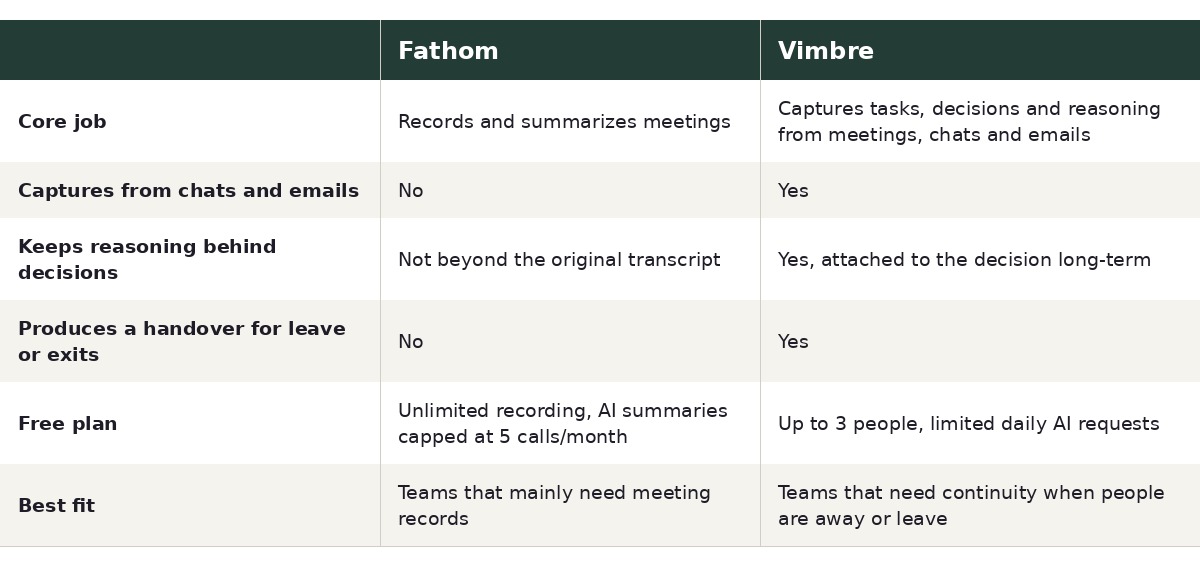
Fathom records, transcribes, and summarizes your video meetings automatically across Zoom, Google Meet, and Microsoft Teams. Its free plan is genuinely generous by the category's standards, unlimited recordings, transcription, and storage, with the catch being that advanced AI summaries and action items are capped at 5 calls a month on the free tier. Paid plans move you past that cap, with Premium priced at $20 a month per user billed monthly, or $16 a month per user billed annually. If what you need is a reliable record of what was said and a usable summary afterward, Fathom does that job well, and its free tier makes it an easy first tool to adopt.
Where Fathom Stops
Fathom's job ends roughly where the meeting ends. It gives you a transcript, a summary, and a list of action items pulled from that one call. What it doesn't do is connect that call to the five other places the same task or decision might get mentioned, a Slack thread, an email, a follow-up call next week. Each meeting is its own island. The reasoning behind a decision made in March doesn't automatically resurface when someone questions that decision in September, you'd have to go dig up the original call. It also isn't built for continuity. If the person who ran that meeting goes on leave or leaves the company, Fathom doesn't produce anything like a handover, it has the transcript, not a structured record of who owns what and why.
Where Vimbre Picks Up
Vimbre captures tasks, decisions, and reasoning not just from meetings but from chats and emails too, and keeps them as a living record rather than a per-call summary. When a decision gets made, the reasoning behind it stays attached to it, so it's there months later when someone asks "why did we do it this way." And when someone's away or leaves, that same record becomes the handover, selected tasks and decisions, reviewed and sent to whoever's covering, Vimbre was built around that exact problem, a handover document that's current because it's been building itself as work happens, not written from memory on someone's last day.
The two aren't really competing for the same job. Fathom is a strong choice if meeting capture is the whole need. Vimbre fits better when the actual problem is knowing what's open, why a call was made, and what happens to that context when someone's out.
Side by Side Comparison (Fathom vs Vimbre)
Vimbre gets you organized, meeting notes and chat context included. Vimbre structures decisions and context into a handover someone else can actually act on when you’re gone. If your team needs good meeting notes, Fathom does that well. If your team needs to survive someone leaving without the knowledge walking out the door with them, that’s what Vimbre is built for.
Frequently asked questions
Is Vimbre a Fathom alternative?
Not a direct one. Fathom is a meeting notetaker, Vimbre is work continuity software. If you only need meeting transcripts and summaries, Fathom's free plan is hard to beat. If the actual problem is losing track of decisions and context when someone's away or leaves, that's a different job, and it's the one Vimbre is built for.
Can I use Fathom and Vimbre together?
Yes, they're not mutually exclusive. Some teams run a meeting notetaker for the call itself and a separate system for tracking what came out of it long-term. Vimbre captures tasks and decisions from meetings, chats, and emails, so it works whether or not you're also running a dedicated notetaker.
Does Fathom's free plan really stay free forever?
Yes, by most independent reviews, Fathom's free tier includes unlimited recording, transcription, and storage indefinitely. The limitation is on advanced AI summaries and action items, which are capped on the free tier, not on the recording itself.
What happens to Fathom's meeting data if someone leaves the company?
The recordings and transcripts stay wherever your workspace stores them, but nothing automatically turns that into a handover. Someone still has to go back through old calls to reconstruct what the departing person knew. That manual reconstruction is exactly the gap our piece on knowledge loss when staff leave goes into.
Does Vimbre record meetings the way Fathom does?
Vimbre records through your microphone after everyone's agreed, and you choose whether to transcribe and review before anything gets turned into tasks or decisions. The difference is what happens next, Fathom's output is the summary itself, Vimbre's output is a living record that keeps getting added to from chats and emails too, not just the call.
Which one is better for a small team?
It depends what's breaking. If meetings are getting forgotten and nobody has notes, Fathom's free plan fixes that cheaply. If notes exist but nobody can explain why a decision was made three months later, or a sudden departure leaves a gap nobody can fill, that's a continuity problem, and it's worth reading our employee handover template either way, whichever tool you're using for meetings.
Keep decisions and handovers in one place
Use Vimbre to turn conversations into a shared record of decisions, next steps and who owns them.
Start free with Vimbre →